
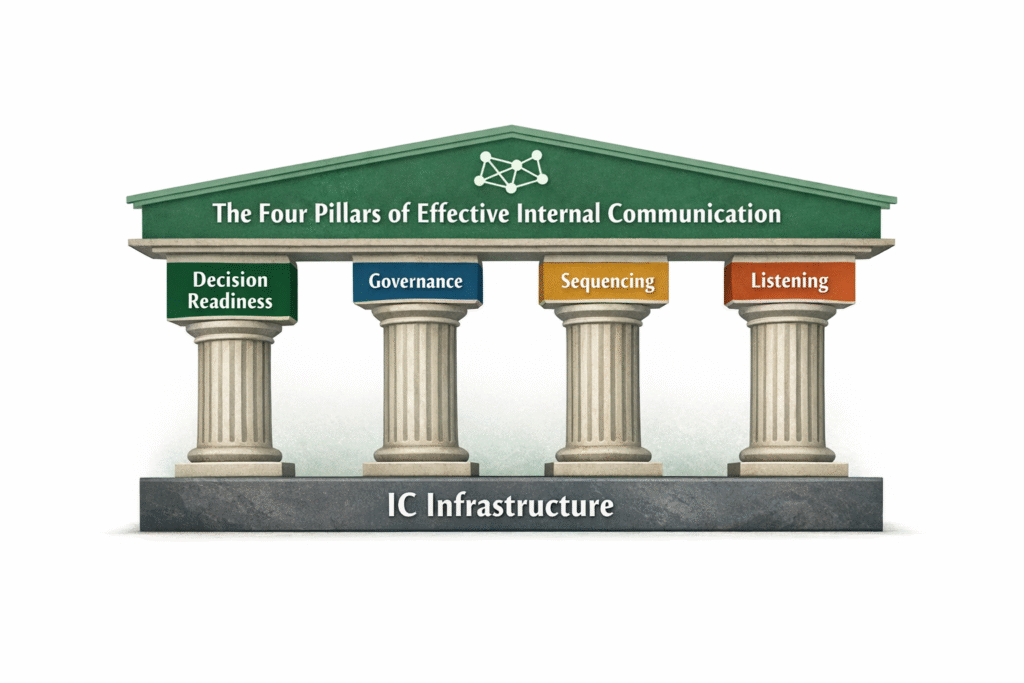
Most internal communication challenges aren’t messaging problems. They’re infrastructure problems.
When communication breaks down, the instinct is often to adjust the message or change the channel. But messaging and channels can only do so much. If decisions aren’t aligned, ownership isn’t clear, or context is missing, communication becomes reactive — clarifying, correcting, and rebuilding trust after the fact.
For internal communication to create shared understanding, alignment, and action, it needs a stronger foundation.
I think about that foundation as four core pillars: decision readiness, governance, sequencing, and listening. Together, they form the infrastructure that supports how communication actually works inside an organization.
When this infrastructure is in place, communication flows more smoothly because decisions, ownership, and context are clear before messages are shared. When it’s not, people move forward based on what makes sense locally and misalignment follows.
While these pillars work together, each plays a distinct role.
Decision Readiness
Decision readiness is the starting point for internal communication.
It focuses on leadership alignment as a decision evolves — from early idea to final direction. Without it, organizations fall into a familiar pattern: an idea is introduced, leaders interpret it differently, and communication starts before the decision is fully formed. Teams begin acting on incomplete information, leading to confusion, frustration, and rework.
Decision readiness creates a pause. It helps leaders clarify:
- What stage the decision is in
- What is known (and not yet known)
- When it’s ready to be shared more broadly
When internal communication is engaged during this phase — not after — the result is greater execution efficiency and stronger trust in leadership.
Governance
Once a decision is made, governance determines how it moves.
Governance clarifies:
- Who owns the decision
- Who is responsible for execution
- Who is responsible for communication
Without clear governance, decisions either stall or create noise. Work slows because no one is accountable or it accelerates chaotically because too many people are acting at once.
With governance in place, ownership is clear. People know their roles. Internal communication can then focus on intentional design rather than chasing alignment after the fact.
Sequencing
With a decision finalized and ownership defined, the next question is not just what to communicate but when and to whom.
Sequencing is the design principle behind the communication cascade. It considers timing, order, and preparation to ensure that communication builds clarity rather than confusion.
It answers questions like:
- Who needs to hear this first?
- What context do they need before others hear the news?
- What order will reduce disruption and increase stability?
Hierarchy often informs sequencing, but impact is often the better guide. The more a group is affected, the earlier and more thoughtfully they should be engaged.
Listening
Once communication is in motion, listening becomes essential.
Listening is how organizations understand how a message is landing and what needs to happen next. It turns communication from a one-way broadcast into an adaptive system.
Effective listening includes:
- Manager feedback loops
- Pulse surveys
- Live Q&A and employee questions
- Focus groups and one-on-one conversations
Just as important is what happens after: identifying patterns, understanding concerns, and adjusting messaging or support in response.
A System, Not a Function
Internal communication works best when these four pillars are in place, supporting the messages and channels we typically associate with the discipline.
Without them, communication becomes reactive. With them, communication becomes a system — one that enables clarity, alignment, and action at scale.